Saturday, 10 January 2015

Deserter Recaptured!

Lamming PI 6: Prussian Line Infantry Drummer
Recaptured for the Fatherland!
I was determined to get my Silesian line infantry finished before going on holiday next week, but as this is looking increasingly unlikely, I've decided to post the only thing I've got to show at the moment.

Lurking among some Hinton Hunt South Germans I acquired recently (of which much more in future posts) was this wee chap. Rather than have him shot for desertion, I decided that he should be conscripted into my line battalion forthwith. Prussian drummers are in short supply here in the Chateau d'homme de Wellington!


Lamming PI 6: Prussian Line Infantry Drummer
Acrylic Gloss, naturally!
Retro wargame figure connoisseurs will recognise him at once as one of Bill Lamming's creations: that Easter Island profile is unmistakable! Another helpful clue was the "PI/6" I found inscribed under his base, which is the code Bill used for Prussian line infantry drummers. I never met Bill, but I suspect that he had a conservative dress sense and a liking for order and precision. I swear that there are creases down the front of those trousers.

He's not a perfect fit for Hinton Hunts, truth be told - those enormous hands, apart from anything else....However, I'm delighted with him nonetheless. I'd cheerfully paint whole battalions of Lammings if I could get them!


Monday, 5 January 2015

A General Answer

There was nothing for it after yesterday's post but to rush out after work and purchase some acrylic gloss varnish.

His buttons and other metallic bits didn't budge an inch!

Hinton Hunt PN 64
PN 64 in all his new, shiny glory

Hinton Hunt PN 64 Rear View
The other side. Red bits are redder in reality!

My heartfelt thanks, chaps.

WM

Sunday, 4 January 2015

A General Question

Wellington may be a small town in the great scheme of things, but it's got fantastic second-hand book shops. Just a few months ago I was absolutely delighted to find a copy of David Nash, The Prussian Army 1808-1815 (London: Almark Publications, 1972), which is still reckoned by some to be the best single English language source for Prussian uniforms.

However, I'm a little confused about his description of general officers' uniforms. On page 77 he writes that on campaign Prussian generals wore "a soft, grey, peaked Schirmutze piped in scarlet". As the accompanying illustration on the next page isn't coloured, there are a number of ways this could be interpreted. Whereas Blucher is almost always depicted with a red band around his old blue Landwehr cap, Nash makes no mention of such a thing for the 'official' cap.

Below is my interpretation of what Nash may have been getting at. The figure in PN 64: Prussian general looking through a spy-glass. Has anyone seen or heard of a cap of this type? It has a rather WW1 appearance!

Hinton Hunt PN 64: Prussian General
PN 64: Prussian general looking through a spy-glass.
He's not been varnished yet, so there's still time to change him. Alternatively, I could always paint on a black oilskin cover!

Another question is: has anybody discovered a way to put Humbrol gloss varnish over Humbrol metallics without the metal colour running about all over the place? I'm very fearful about his buttons!

Tuesday, 30 December 2014

Linesmen

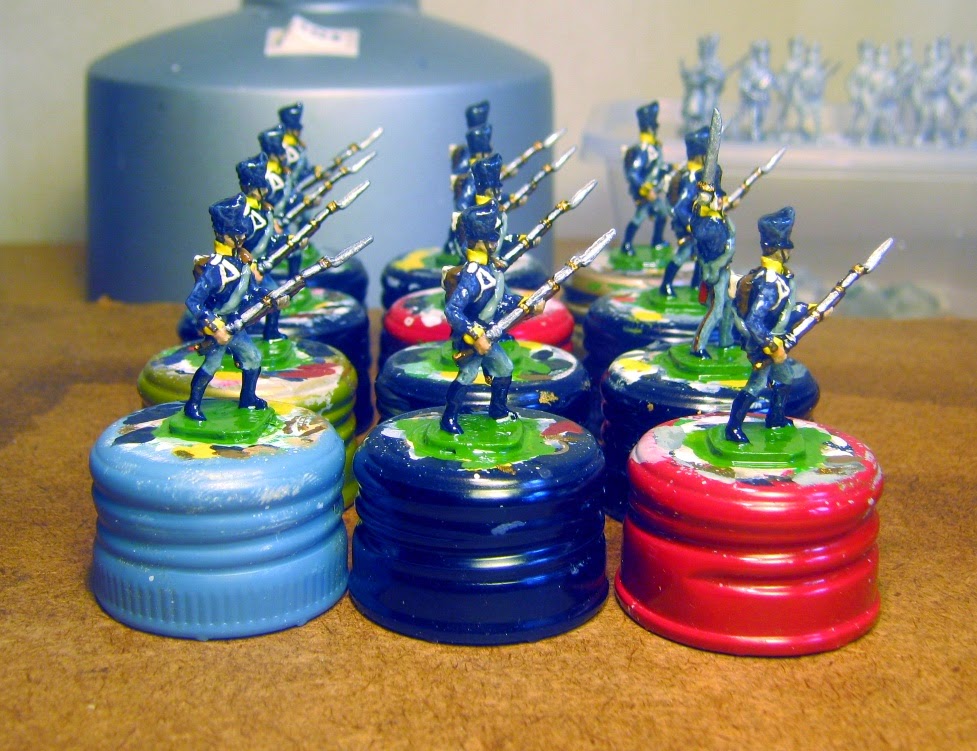
My Prussians are starting to look a bit elitist, so it's time to do a few line infantry.

I read somewhere that the way to do armies is to paint them in small batches, so I've decided to try painting 12 figures at a time. This fits in well with the 24-figure battalions that I've opted for. Getting half a battalion done looks like progress, so it keeps me motivated to get on and complete the other half. I also find that 12 figures is just about the maximum it's possible to do before each particular blob of enamel colour I'm working with dries out.

The main drawback with Prussians, they say, is their rather sombre uniforms. However, I couldn't help noticing that the 10th (1st Silesian) Infantry Regiment had rather fetching yellow facings....

The first batch of twelve are shown below. The figures are Hinton Hunt PN 3: Prussian Line Infantry Private, Charging; and PN 1: Prussian Line Infantry Officer, Charging.

PN 1 Hinton Hunt Prussian Line Infantry Officer Charging
Taxi!
PN 3: Prussian Line Infantry Private, Charging
Who says Prussians aren't pretty?
Nach Paris!
OK, so maybe the red turnbacks and yellow collars clash a bit, but you can't have everything.


Sunday, 28 December 2014

Guards! Guards!

Next up are the Prussian Foot Guards.


Before repainting. A sturdy looking set of PN 13: Prussian Guard Grenadiers, Charging.
PN 13 from the rear
Stripping off the paint revealed that all was not quite as it seemed! About half a dozen of them were clearly not original Hinton Hunts.


Mystery figure on the left, Hinton Hunt on the right. The mystery figure has slightly less detail and is made of a darker, less dense alloy. His stance is also slightly set back, as if balancing on his right foot.


HH on the right. Definitely a bit beefier.


There are also slight differences in the thickness of the bases and the mold lines. The mold line variation is clearest on the boots.
I'm almost certain that the mystery figures were made by Der Kriegspielers (DK), an American company that produced a range of 25mm Napoleonics in the early 1970s. Marketed as "Napoleoniques", the DK range closely resembles those made by Hinton Hunt. According to the DK 1970 and 1973 catalogues (here), the DK equivalent to my HH Prussian guardsmen are "Napoleoniques" set 121: Prussian Guard Battalion 1812 Advancing.

(Many thanks to Chuck for the catalogue information).

Another discovery was that the drummer I had selected  was a conversion. So much became clear when his head fell off as I was cleaning him! However, a pin and a bit of superglue soon put him right again. I suspect he is a PN 6 (Prussian Line Infantry Drummer), with a Guardsman's head.


PN 6 with a new head. Not an easy figure to paint. Much of the detail is paint rather than sculpting, and the drum was anything but symmetrical.


Side view, looking very spiffy with his poppy red facings and plume.
To finish the battalion I made another conversion to make the standard bearer: PN 5 Private, Prussian Line Infantry, advancing (Separate Musket), but with another Guardsman's head. I thought it would also be fun to have a go at hand-painting the flag. The final result, representing the First Battalion/First Garde-Regiment zu Fuss, is shown below.
PN 13; PN 10: Guard Officer Charging; converted PN 6: Line Drummer; and converted PN 5: Line Infantryman.


I've yet to decide whether or not to stick with this basing scheme, but we'll see how it goes. It certainly makes it a lot easier to pick them up and move them around.

WM

Saturday, 20 December 2014

Getting things started

Greetings from far away New Zealand.

As a lad growing up in Britain I was fascinated by the photos of toy soldiers and instructions on how to fight battles with them to be found in wargames books by the likes of Charles Grant, Don Featherstone and Peter Young. I think I must have had the wargames section of my local library out on loan more or less continuously. By the time I was old enough to try painting an army of my own, however, the figures depicted in those books and the manufacturers listed in their indexes had already all but disappeared.

It wasn't until  earlier this year, and half a world away, that I found what I had been looking for - a small army of Hinton Hunt Prussians! There were 97 of them altogether, organised as three battalions of grenadiers and a few companies of jaegers.

First up, I reckoned, should be the Prussian Jaegers. These looked like just the thing for someone like me who hadn't painted a figure for about 30 years. Couldn't be more simple!
 
(Apologies to those that have already seen some of these on The Miniatures Page, but they're all I've got to show at the moment. The previous TMP post is here)

These were originally organised in six 4-figure companies, making a total 21 advancing jaegers, two marching officers and a bugler. I thought they'd do rather well as four 6-figure companies to make a single battalion of 24 figures.

24 of Marcus Hinton's Finest, but needing a bit of TLC
Hinton Hunt PN 27: Prussian Jaegers Advancing
PN 27: Prussian Jaegers Advancing
Hinton Hunt PN 24: Prussian Jaeger Officer Marching; PN 25: Prussian Jaeger Bugler Marching
PN 24: Prussian Jaeger Officer Marching; and PN 25: Prussian Jaeger Bugler Marching.
.
And so, the great experiment began. It was a bit nerve-wracking to strip off all the paint. Nonetheless, I got stuck in, and here were the results:

Hinton Hunt Prussian Jaegers
On the painting table. I chose a rather bright green for the uniforms in the expectation that a gloss varnish would tone it down a bit. It sort of worked....
Hinton Hunt Prussian Jaegers
Getting there
The paints I used were humbrol enamels, finished off with two coats of gloss varnish. The gloss, as expected, made them a lot darker, but also gave tremendous depth to the colours.

Hinton Hunt Prussian Jaegers
I was particularly chuffed with the bugler! A beautiful figure.

Hinton Hunt Prussian Jaegers
A rear view of PN 25.

Hinton Hunt Prussian Jaegers
The complete battalion.

Hinton Hunt Prussian Jaegers
The regiment they are supposed to represent are the 2nd Silesian Shutzen, for no other reason than I rather fancied their red-piped black facings!

They took me about 7 days to complete altogether, so not nearly as simple as I had assumed. However, there was no rush to get them finished. The main thing was to see if I still had any trace of the skill and patience needed to complete them.

I'm still uhming-and aahing about how to base them.

Comments welcome!.

Merry Christmas and a Happy New Year, WM