Saturday, 20 February 2016

Coke Can Kürassier

Having decided on a push for Prussians, I've brought the second squadron of the Garde du Corps to the front of the painting queue.

Pictured is the trooper I've selected to carry the standard of the regiment. I thought I'd give coke-can metal a go for the flag to see how it behaved in comparison to paper. It was surprising simple to do, and I'm particularly pleased with the sharpness of the waves and folds that it was possible to put into it. It also looks as if it will be a lot more durable than any of my paper flags. The drawback is that I don't think it will be possible to paint designs on flags of this type before they go on to their poles.

The baldrick around his shoulders was made by simply hammering a length of solder flat and then cutting it into a strip. The whole assembly was then liberally stuck down with super glue.

I spent a very pleasant couple of hours putting this all together. It's going to take a little longer to paint!

WM

Saturday, 13 February 2016

Vorwärts and all

Hinton Hunt PN 60: Marshal Blucher
Marshal Blücher signals a turn to the right
To celebrate the completion of the 2nd Leib Hussars. which is my first full, 12-figure cavalry regiment, I thought it would only be right and proper to have them inspected by that ultimate old hussar, Generalfeldmarschall Gebhard Leberecht von Blücher.

The figure is PN 60: Marshal Blucher, on horse PNH 1, and is another one of John Cunningham's very fine Hinton Hunt recasts.

The Marshal is wearing the blue and red cap that I think is correct for a Prussian cavalry general, but as was the case when I painted General Bülow, I'm not completely sure....

Hinton Hunt PN 85: Prussian Hussar, Charging
The Leib Hussars veer to the right as directed and thunder by
There aren't too many ways to paint his grey greatcoat and overalls. The flash of red lining under his cape, however, is based on nothing much more than the absolutely inspired version of this figure painted by Ian S. You can see him here on Ian's extraordinary Hinton Hunt Vintage Wargame Figures Blog. I just couldn't paint my Blücher any other way after seeing Ian's version.

Hinton Hunt Prussian Napoleonic General Staff
A trio of Prussian generals admire the spectacle.
Blücher's completion leaves me with only one more Prussian general staff figure yet to do, which is the aide de camp figure. Anything after that and I'll have to start doing some conversions. Fortunately it looks like it should be possible to achieve quite a lot in this respect with a just a little head swapping!


Sunday, 7 February 2016

Preußische Piraten 2

Hinton Hunt PN 85: Prussian Hussar
Readers of this blog may have noticed a tendency to flit from cavalry regiment to cavalry regiment without completing anything. I think this was partly because it allowed me to put off an an important decision, which was whether or not to have a go at doing any command figure conversions!

Pictured are my first two attempts, being an officer and a trumpeter of the 2nd Leib Hussars.

Hinton Hunt PN 85: Prussian HussarThe officer was very simple, requiring no more than the removal of his carbine and a slightly different colour scheme.

The trumpeter, on the other hand, was a little trickier as the trumpet is constructed entirely out of solder using a technique known as "stringing". It was the noted Hinton Hunt collector and converter, Steve C, who told me how to do this. Steve's own words tell it best, so here they are:

"I use a 30 watt ANTEX iron with a taper tip. It took me years to get it right but I find the best way is to melt a non-fluxed plumbers solder wire onto the tip and let it build onto the tip until it's almost dripping off . This I think is the critical part.

Clean the figure to be repaired by filing and leaving a bright alloy surface, then gently touch the drop of solder onto the piece to be rebuilt, then 'tease' the iron gently away as the solder stretches. As soon as you have the required length of solder, press the joint into a wet sponge to quench it and it will harden the lead alloy straight away ready for filing to shape .

If you try to be too fast the solder just pulls away, if you try to be too slow you burn the figure away".

Steve's advice also woke me up to the fact that soldering iron wattage is actually quite important. Higher powered soldering irons are probably much too hot for work of this kind!

WM

Friday, 15 January 2016

On Being Shiny

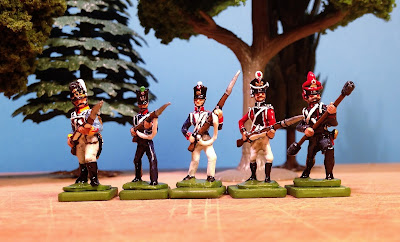
Der Kriegspieler and Hinton Hunt Napoleonic Infantry and Artillery
Types of the French and Bavarian Armies.

One of the things I'm most frequently asked is: "why all the shininess?", swiftly followed by: "so how do you get them so shiny anyway?"

I could waffle on for ages about why I opted for a high-gloss finish, but all it really boils down to is that I like them that way and it's the way I've always done it. Why I like them that way is for three main reasons.

The first is nostalgia: it is what the very first soldiers I ever saw looked like.

The second is bloody mindedness: I've always had a bit of a contrarian streak and occasionally like to do things because they are unfashionable.

The last, and by far the most important, is that it looks great! A gloss finish will make even the most pedestrian painting suddenly start to look altogether more glamorous.

What is all this wizardry?
There are other reasons too, of course. A gloss finish is arguably more in keeping with vintage Napoleonics, and a couple of coats provide a tremendous amount of protection for figures destined for quite extensive handling. But it is the aesthetics that are the main thing as far as I'm concerned. I like my toys to look like toys, and I like them to look like the very old-fashioned toys that they are too.

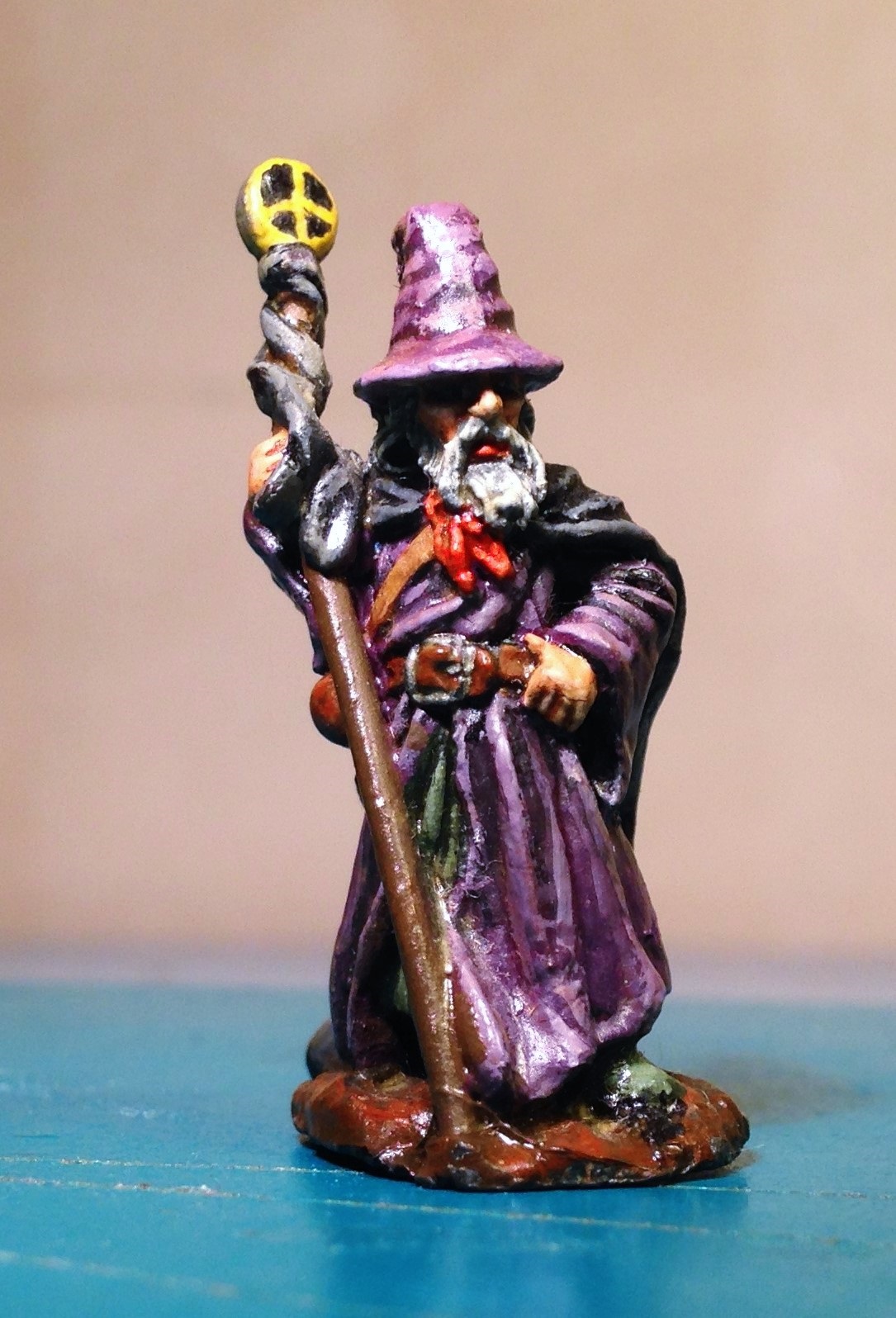
Pictured is one of the very last figures I painted before I took up with Hinton Hunts. He was painted in about 1983, when I was seventeen, for the Advanced Dungeons & Dragons game that a small group of the more miserable and lonely of us used to play during the lunch hours at Cherwell Comprehensive School in Oxford. I painted him this way because I had a pot of purple Humbrol paint that I couldn't find any other use for. The Campaign for Nuclear Disarmament symbol was meant to be a kind of back-handed, ironic statement about how deeply and irredeemably uncool we were compared to just about everybody else in the 6th Form. What really enraged my fellow AD&D comrades (who were a rather Thatcherite bunch), however, was not the leftist symbolism but the fact that I'd made him all shiny. They thought it was dreadfully unrealistic. I still laugh about this.

Drago the Magnificent (for it is he) was varnished with a plain old Humbrol Gloss varnish which has stood up rather well, but then he has spent all but about three weeks of the last 33 years in total darkness. Nowadays I use something that looks altogether more advanced:


It is Winsor & Newton "Artisan" Water Mixable Oil Gloss Varnish. I buy it from a local art shop. It only comes in quite small bottles, unfortunately, and it's quite expensive. The bottles are also very easy to tip over, as happened to me a couple of times. I now decant the things into a sturdy jar.

I use two coats. I find that it adds tremendous depth and contrast to the colours on my DKs and Hinton Hunts. Black, for example, goes really black, and it makes reds, whites and yellows positively glow. 

I give the first coat half a day to dry before adding the second and it takes quite a while to dry out properly. Although you can handle the figures after a couple of hours, it doesn't really dry out for a week. When it does, however, it dries very hard and provides a really tough protective coating for the troops. It stiffens muskets, flags and other bendy bits pretty well too. It also provides UV protection, according to the bottle, and doesn't yellow with age. Brushes are washed out with water.

It has no adverse effects on Humbrol enamels, and the ever troublesome metallics remain absolutely solid. It does, however, tend to make water-soluble inks run. As a result I have a second, oil-based gloss varnish that I use to dab onto any areas where I've used inks (such as white waistcoats and flags). A word of warning: I've no idea how it behaves with acrylics!

Der Kriegspieler and Hinton Hunt Napoleonic Infantry and Artillery
Types of the Prussian Army.
Yours, as ever

WM

Saturday, 9 January 2016

Pole Position 2

Der Kriegspielers DK 39: Polish Line Lancers

Der Kriegspielers DK 39: Polish Line Lancers
I am pleased to present the first squadron of the 7th Chevau-Légers Lanciers.

They were really fun to paint. I hesitate to say it out loud, but I may be beginning to get over my cavalry aversion.

I don't have enough castings to make up the second squadron, so they will probably form part of a mixed regiment of light cavalry for the time being.

Der Kriegspielers DK 39: Polish Line LancersHowever, all that will have to wait as reinforcements for the Leib Hussars have finally arrived. I really ought to get at least one 12-figure regiment of cavalry properly finished!

Have a great weekend.

WM

Saturday, 2 January 2016

The Neys Have It

Hinton Hunt FN 354: Marshal Ney
Mrs WM: "Is that Napoleon?"
WM: "Ney, Lass".
I've been a very lucky laddy.

I had a suspicion when I first saw this figure that I knew which painting had been the inspiration, and seeing them side by side I think there can be no doubt about it!

The figure, of course, is Hinton Hunt FN 354: Marshal Ney, on horse FNH 10.

The painting is a detail from Ernest Meissonier's 1864 painting, Campagne de France 1814.

WM