Showing posts with label Burbling. Show all posts

Sunday, 27 September 2020

Clonk

That being the sound of my pious painting intentions shattering against reality. I've made virtually zero progress this weekend due to a cascading series of domestic issues, each trivial in nature but sufficient in aggregate to keep me away from the painting table.

Herewith one from the archives to serve as a teasing foretaste of the grand French cavalry review that will eventually...er...eventuate:


Yours, thoroughly browned off

WM

P.S. Blogger has been playing silly buggers for a while now. If I receive a comment I invariably publish it, so if you have not seen your comments appear it's because Blogger has failed to transmit them to me for some reason. If this is the case, please don't hesitate to use the snazzy new message form I've added to the front page, and I will publish your comments on your behalf.

Wednesday, 13 May 2020

Prussian Discussion

I have hinted now and then that I'm a bit of a fan of Lamming 20mm Napoleonics. I've tried to hide this, of course, but that regiment of Lamming British Line infantry, and my tentative experiments with some of the French part of the range, I fear, may have let the cat out of the bag.

What I've really been yearning for all along is a battalion of Lamming 20mm Prussians. I knew these existed because I already had one - a charming little drummer who I conscripted into the Prussian 10th Infantry Regiment. Here's a reminder of what he looks like:

Lamming PI/6: Prussian Line Infantry Drummer
I identified him from his looks and from the fact that he has 'PI/6' inscribed underneath his base, which is listed as a Prussian Line Infantry drummer in the Lamming 20mm range. The only other things I had to go on were a few glimpses in the wargaming literature of what I believe were Lamming Prussians in the Peter Gilder collection, and an intriguing post about the same collection by Clive over on his Hinton Hunter site.

Imagine my delight, therefore, when a number of Lamming Prussians, or what looked like them, popped up in three different lots, from three different vendors, on ebay. Pictured below is the haul. Lot 1 included the figure stripped to the metal in the second row; Lot 2 are all those painted light blue; and Lot 3 are the chaps in dark blue in the front row.


Once I'd got them altogether, however, it became clear that there were several weird things about them. The first question was: why is the officer so much larger than the rest of them? Did Bill intend him to be like this (Bill's officers do seem to be a bit bigger, on the whole), or was he part of a later, remodelled set of Lamming Prussians?


Lamming 20mm PI/6 Prussian Line infantry drummer, PI/1 Prussian line infantry advancing,
and a somewhat oversized PI/3 Line infantry officer

This is where Lot 4 comes into the picture, which I bought from a fellow living here in New Zealand. Lot 4 consists of an identical officer and half a dozen advancing infantryman who are really very different and altogether taller than the other lots. They are not, however, examples of the final range Bill Lamming produced in 1974/5. These, as shown in an earlier post, were a great deal beefier. Pictured below are two of the Lot 4s added to the line up.


An intriguing Lamming line up: a PI/6, two  PI/1s (first variant), a PI/1 (second variant) and two PI/3s (second variant?)

The next shot shows what's underneath the bases. As you can see, the two advancing infantry variants have PI/1 inscribed on them, while the officer sports a PI/3.


As if this wasn't confusing enough, two of the Lot 3 men were also noticeably different to the men in Lots 1 and 2. The next two pictures should show what I mean.

Lot 2 and Lot 3
The Lot 3s are slightly taller than the Lot 2s, and have slightly thicker and taller hats, different arms and legs, and larger, slightly misshapen bases. The torsos and blanket rolls are very similar, however.


Also different are the swords and muskets. The Lot 2s have a very simple sword moulded to the side of their left legs, while the Lot 3s have hanging swords. The packs are very similar though.

What to make of it? When I first saw them I thought the Lot 3s looked remarkably as if someone had grafted a Lamming head onto the body of a Hinton Hunt Prussian infantryman. The following, I hope, will illustrate what I mean.


Lamming PI/1, Unknown and Hinton Hunt PN 3: Prussian Infantry of the Line, charging

This initially made me think the Lot 3 chaps must be Alberkens. Peter Gilder, the Alberken designer, often appears to have used Hinton Hunts as the basis for the figures in the Alberken range. I'm not completely convinced about this, however.

The question I'm asking myself is: which came first? My feeling at the moment is that the date order is probably right to left: Hinton Hunt, Lot 3 and then Lamming.

The Lot 3 looks like a Hinton Hunt, but with a new head and a lightly modified pack, blanket roll and sword. The Lamming looks like a further modification of the Lot 3, if anything, with new arms, legs, sword and musket, but retaining the torso. This may also account for the slight shrinkage in the hat and other details, which is not an unusual result of the recasting process.

My conclusion is that the Lot 3s, which I initially thought were Alberkens, may actually be a very early iteration of the Lamming Prussian range. It looks to me that Bill may have started out by modifying a Hinton Hunt or two.

Clive and I have already had a lively email debate about all this. As can be seen on the wonderful Old Metal Detector Blog here, Clive is far from convinced, but for what it's worth, my theory about Lammings is that there were more than just two versions of the range, which is to say a 20mm range and a more or less completely resculpted 25mm range. If the evidence presented above is anything to go by, Bill seems to have tinkered quite a lot with the 20mm figures, including completely remodelling some of them, before tossing the lot in favour of 25mm figures. More than a few vintage Prussians, however, will be needed to prove this, so if anyone else has examples of these figures or any tales to tell about them, please get in touch!

Yours, as ever
WM

P.S. Evidence of 'tinkering', although of a very modest variety, can also be found in the French part of the Lamming 20mm range, which I will illustrate in a later post.

Edit:
Some really splendid early Lamming British Royal Horse Artillery can be seen on Rob Y's site here.


Tuesday, 24 March 2020

Prussian Posse

New Zealand goes into lockdown for four weeks in 24 hours, so to cheer myself up (and anyone else who might be watching), I've gathered together my German generals. Blücher will know what to do!

To all my friends, stay safe old chaps. I'll see you all again one day, no doubt, if you don't see me first.

All the best
WM

Monday, 27 August 2018

The End of the Line

Having belatedly finished the two centre companies of my new French line Infantry battalion, I have to decide what to put on the flanks.


There are three main options:

Option one is well-stocked grenadier and voltigeur companies à la Wellington Man. This has become something of a house standard, driven for the most part by the figures I happened to have lying about:


Option two is to represent the elites in their proper portions (i.e. as no more than a third of the battalion), as demonstrated by Mark Dudley:


Option three is fusiliers all the way, which is the speciality of Monsieur Stryker:


I can't make up my mind.

WM

Saturday, 16 December 2017

A Wargaming Classic

One of the reasons I've wanted to paint Garrisons for so long is that masses of them appeared in the war games books I read when I was a lad. A lot of the photos in these books, of course, were of Peter Gilder's amazing collections. I didn't know they were Garrisons back then, but I thought they were magnificent all the same.

The all-time classic photo of Peter's troops, as far as I was concerned, was the one that appeared on the dust jacket of Bruce Quarrie's Napoleon's Campaigns in Miniature, published in 1977. The whole cover can be seen here. I spent hours staring at this picture and wondering where the figures came from.
A lot of the soldiers shown marching to their doom at Waterloo in this photo, I now realise, are Garrisons. The detail from the dust jacket I've posted below ought to show what I mean. Those are definitely Garrisons in the back two rows of the column in the foreground, and I think they make up most of the third and fourth rows in the other column as well.


Also depicted, of course, are zillions of Hinton Hunts and Hinchliffes. I'm almost sure that the chaps sporting the red and yellow plumes and marching beside them, however, are Lamming French line voltiguers, although what they're doing in company with the Imperial Guard is anybody's guess. The British on the ridge, by the way, look like S-Range Minifigs and Lammings to me, but if anyone knows better please don't hesitate to say so in the comments.

My own Garrison guardsmen, painted to represent line infantry grenadiers, are shown below. The figures are all Garrison FN 2: Old Guard Grenadier Advancing.


The last two fusilier and voltigeur companies are now on the painting table, but it remains to be seen whether or not I can get them finished before Christmas. Just in case I don't, here's the first half battalion to be going on with:


That's it for now,

WM

Edit: I've added in an extra photo to show how the FN 7 Fusilier and the FN 2 Grenadier compare. I hope it illustrates what I was trying to get at in my comment to 'Lee. The fusilier has a slightly quizzical look somehow - I think it's something to do with the deft little side step he's making, and the slight tilt of his head - like he's trying to decide whether to charge or bolt!


Sunday, 26 November 2017

Rebooting the Reservists

What with the non-appearance of the rest of my Prussian reservists and all that fooling about with Austrians, it's become painfully obvious that I'd been going through a bit of a soft patch, so radical measures were necessary.

The solution, I decided, was to make a start on something I've been dying to do for well over a year, which is a battalion of Garrison French infantry. Those with very long memories may remember that I painted a test Garrison figure in the middle of last year. He's been sitting about accusingly ever since.


The Garrisons, I've decided, will be an 1809-ish era regiment, complete with fancy flank companies. The command group and the grenadier company will be first, not least because it was an excuse to do a few more conversions and some sword-forging on my rail anvil.

Getting the Garrisons prepared and out onto the painting table, I hoped, would motivate me to get back to work on my Prussians, and I'm very pleased to say this has worked. The Prussians have all their muskets and equipment blacked-up now, which means they're finally past the half-way stage. I find that painting always goes quickly after this point as the troops really start to look like proper little soldiers. The complete battalion is now not too far off at all.

WM

P.S. I haven't abandoned my Austrian project - I've just parked it for a wee while until I've made a little more progress on phase two. This needs two more battalions, a cavalry regiment and two gun batteries before I can claim to have reached the half-way point.

Sunday, 19 November 2017

Amateur Austronomy

I know, I should be working on Prussians, but all this fooling about with Austrians has distracted me. I couldn't resist getting them all out to have a look at them and to decide which, if any, could be cobbled together into a battalion.

It turns out that there are 98 of them - enough for four battalions with a couple to spare. For those curious to know what 98 distinctly dodgy-looking Austrians look like, they are pictured below.

Bring on the Clones
There was nothing for it after that but to get out my small collection of genuine, factory-painted Alberken/Minifig Austrians by way of comparison. These particular examples, I believe, are:

12 x AN 1W: German Line Fusilier, on guard;
2 x AN 2W: German Line Fusilier Officer;
1 x AN 15W: German Line Fusilier Standard Bearer; and
1 x AN 4W; German Line Grenadier Officer.

The Albert and Ken's

The good news is that having had a closer look at the home-casts, I decided that there may be, just possibly, a dozen or so which are genuine, in which case they're probably examples of the Alberken/Minifig code AN 5 or AN 5 W: Hungarian (or German) Line Fusilier, advancing.

The last shot is a closer view of what is definitely not an original, what might be an original, and one of the AN 1Ws. Do you know, I think one could actually make something of all of them: even the one who seems to be half man and half goat, with a bit of soldering.


What do you think? Should I do it?

Incidentally, I've started to post up a few pages about how I went about painting  the first wee man. If anyone wishes to make any comments (complementary or critical: both are very welcome), proffer advice or ask questions, please don't hesitate.

WM


Saturday, 8 July 2017

Hintonstein's Laboratory

The Estorff Hussars' horses are finally complete and I'm just waiting for the hands and faces of the troopers to dry before moving to the next stage, which will be blocking out the main colours of their uniforms.

In the meantime, as promised, is a brief overview of my conversion equipment, which is a mixture of things I've been dragging about since my teens and some new-fangled technology acquired over the last two years.


The things that get the most use are the microfiles, the craft knife, the soldering iron, the rotary tool and the toothbrush. Coming in close behind them, however, are the hammer and that very solid bit of steel rail in the top left-hand corner. The rail was a present from my next-door neighbour, Richard, who qualifies as one of the world's top blokes. I needed something for forging flagpoles and sword blades and the like and Richard, being Richard, knew just the chap to supply it. He even sent me a picture of it being sliced off a length of railway line. I can barely remember the last time I was so delighted to be given something.


My latest conversion is below, which is based on a Hinton Hunt PN 81: Prussian dragoon (mounted), charging. He was converted at the request of Mr Lewis Gunner, who desired that he be dressed in a litewka. I thought I'd better practice a bit before tackling him, however, which is why I had a go at that DK Prussian foot guards officer featured in the last post.


You can see Ian S's magnificent regiment of the original version of this figure on his Hinton Hunt Vintage Wargame Figures blog, here.

John Cunnigham has very kindly agreed to cast him, so if all goes well he'll be available to anybody who wants to buy him before too long. John has a much expanded list these days and I'm hoping to add a few more conversions to it from time to time.

If anyone else would like me to have go at converting one of their figures, I'm open to suggestions. I really enjoy doing them. All I ask in return is that you become a follower of the blog and are lavish in your praises!

A word of warning, mind: I don't always get it right. Pictured below is my only irreparable disaster to date. I was attempting to repair his bayonet and his perilously thin little DK musket just couldn't bear the heat. I don't attempt this sort of thing these days unless the part under repair is properly supported!


Yours, as always

WM

Monday, 13 February 2017

A bit of a breather and a mystery solved and deepened.

After all the frenetic activity over Christmas to get (most)  of my January 2016 list of "to dos" finished, I needed a bit of a break, so off we flew to the imaginatively-named South Island for a glorious week in the sun. Below is the view from the balcony where we were staying looking over the Akaroa bay. It has to be one of the most lovely spots I've ever seen.

Lovely Akaroa
Any feelings of self satisfaction over the dent in the lead pile I'd managed to make over the year were swiftly dispelled on my return, however. Over the course of a few days the lead pile has increased by 4+  battalions, a battery of artillery and two cavalry regiments! My ever lasting thanks to David, Mark and Tony S for these. It looks like the Hinton Spieler will be trundling on for a while yet.

Tony S also sent me the picture below, with some further intelligence about the mysterious FN2a Hinton Hunt charging French line grenadier variant (he of the hanging musket sling). The man on the left, Tony tells me, is a David Clayton figure which he obtained from the man himself. The chap in the right, however, is rather more Hinton Huntish, being of a softer metal and the chunkier base plugs typical of Marcus Hinton originals. The other main difference, clearly visible in the picture, is their leg positions. The mystery deepens!

Left to Right: David Clayton FN2a and an FN2a from somewhere else!
Rob's magnificent gun team has been staring at me resentfully for long enough now, so I guess I'd better paint it. A final review of the completed Phase One will follow, with a bit of discussion about what Phase Two ought to look like. My erstwhile opponent, JC, is already demanding a rematch with substantially augmented forces!

Yours, cracking on,

WM

Friday, 15 January 2016

On Being Shiny

Der Kriegspieler and Hinton Hunt Napoleonic Infantry and Artillery
Types of the French and Bavarian Armies.

One of the things I'm most frequently asked is: "why all the shininess?", swiftly followed by: "so how do you get them so shiny anyway?"

I could waffle on for ages about why I opted for a high-gloss finish, but all it really boils down to is that I like them that way and it's the way I've always done it. Why I like them that way is for three main reasons.

The first is nostalgia: it is what the very first soldiers I ever saw looked like.

The second is bloody mindedness: I've always had a bit of a contrarian streak and occasionally like to do things because they are unfashionable.

The last, and by far the most important, is that it looks great! A gloss finish will make even the most pedestrian painting suddenly start to look altogether more glamorous.

What is all this wizardry?
There are other reasons too, of course. A gloss finish is arguably more in keeping with vintage Napoleonics, and a couple of coats provide a tremendous amount of protection for figures destined for quite extensive handling. But it is the aesthetics that are the main thing as far as I'm concerned. I like my toys to look like toys, and I like them to look like the very old-fashioned toys that they are too.

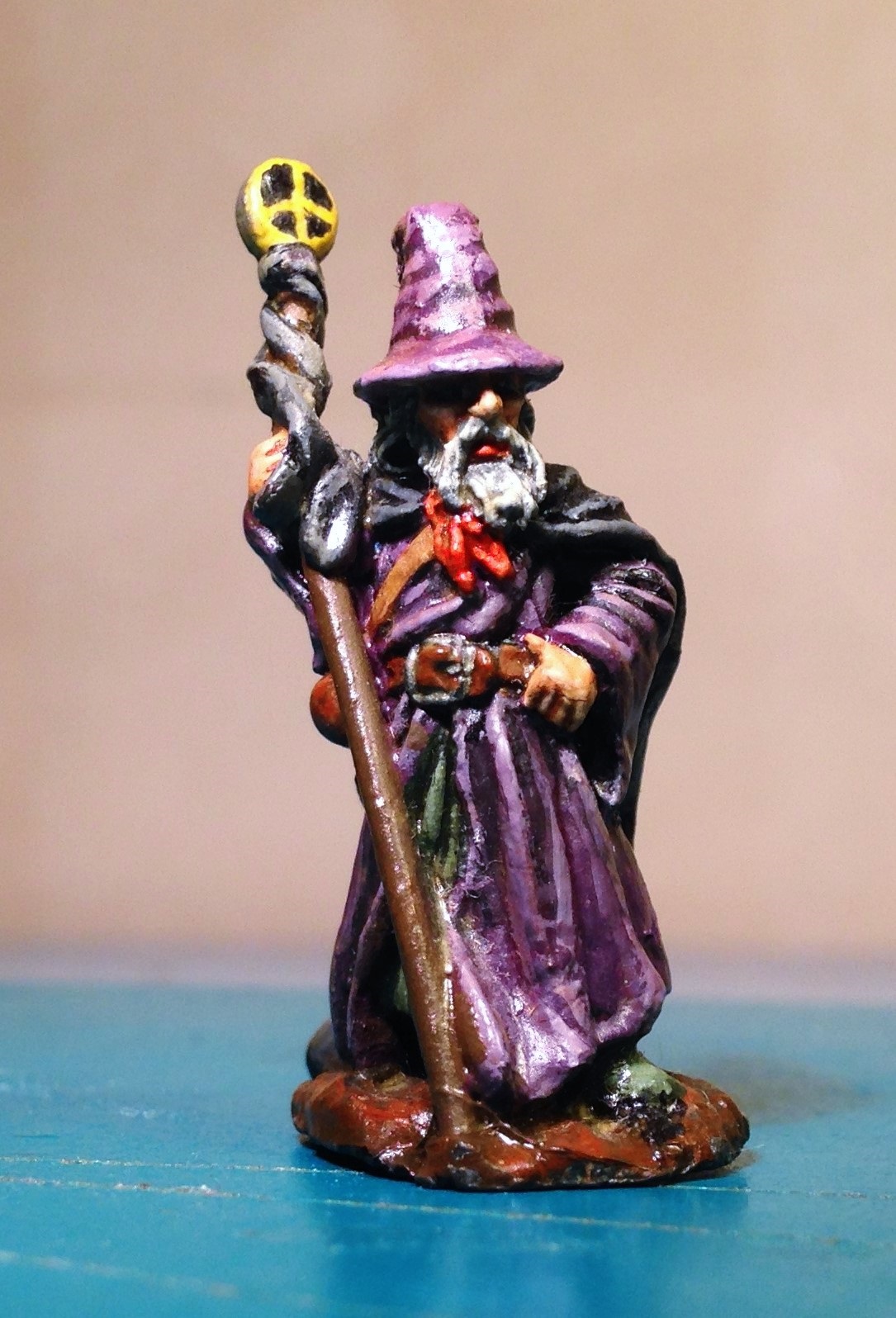
Pictured is one of the very last figures I painted before I took up with Hinton Hunts. He was painted in about 1983, when I was seventeen, for the Advanced Dungeons & Dragons game that a small group of the more miserable and lonely of us used to play during the lunch hours at Cherwell Comprehensive School in Oxford. I painted him this way because I had a pot of purple Humbrol paint that I couldn't find any other use for. The Campaign for Nuclear Disarmament symbol was meant to be a kind of back-handed, ironic statement about how deeply and irredeemably uncool we were compared to just about everybody else in the 6th Form. What really enraged my fellow AD&D comrades (who were a rather Thatcherite bunch), however, was not the leftist symbolism but the fact that I'd made him all shiny. They thought it was dreadfully unrealistic. I still laugh about this.

Drago the Magnificent (for it is he) was varnished with a plain old Humbrol Gloss varnish which has stood up rather well, but then he has spent all but about three weeks of the last 33 years in total darkness. Nowadays I use something that looks altogether more advanced:


It is Winsor & Newton "Artisan" Water Mixable Oil Gloss Varnish. I buy it from a local art shop. It only comes in quite small bottles, unfortunately, and it's quite expensive. The bottles are also very easy to tip over, as happened to me a couple of times. I now decant the things into a sturdy jar.

I use two coats. I find that it adds tremendous depth and contrast to the colours on my DKs and Hinton Hunts. Black, for example, goes really black, and it makes reds, whites and yellows positively glow. 

I give the first coat half a day to dry before adding the second and it takes quite a while to dry out properly. Although you can handle the figures after a couple of hours, it doesn't really dry out for a week. When it does, however, it dries very hard and provides a really tough protective coating for the troops. It stiffens muskets, flags and other bendy bits pretty well too. It also provides UV protection, according to the bottle, and doesn't yellow with age. Brushes are washed out with water.

It has no adverse effects on Humbrol enamels, and the ever troublesome metallics remain absolutely solid. It does, however, tend to make water-soluble inks run. As a result I have a second, oil-based gloss varnish that I use to dab onto any areas where I've used inks (such as white waistcoats and flags). A word of warning: I've no idea how it behaves with acrylics!

Der Kriegspieler and Hinton Hunt Napoleonic Infantry and Artillery
Types of the Prussian Army.
Yours, as ever

WM